If you’ve ever looked at two oak cabinets and wondered why one has bold, flame-like swirls while the other shows tight, straight lines with little flecks of light catching the surface, the answer usually isn’t the stain — it’s the wood cuts. Long before a board ever reaches the finishing room, the way it was sliced from the log determines its grain pattern, its stability, and even its price. For homeowners across Vermont and New Hampshire planning a kitchen or bath remodel, understanding plain-sawn, quartersawn, and rift-sawn lumber can make the difference between cabinets that simply look nice and cabinets that feel intentional.
Plain-Sawn: The Classic, Efficient Wood Cut
Plain-sawn (sometimes called flat-sawn) is the most common way lumber is cut, and for good reason — it produces the most usable wood from each log, which keeps costs down. The growth rings run roughly parallel to the face of the board, creating the sweeping, cathedral-arch grain pattern most people picture when they think of wood grain. It’s a beautiful, natural look that works well in traditional and farmhouse-style kitchens, especially on larger door panels where that dramatic grain has room to show off. The trade-off is that plain-sawn boards are more prone to seasonal movement — a little more cupping and expansion across the width than the other cuts — though for cabinetry, where boards are relatively narrow and well-supported by the frame, this is rarely a practical concern.
Quartersawn: Straight Grain with Real Character
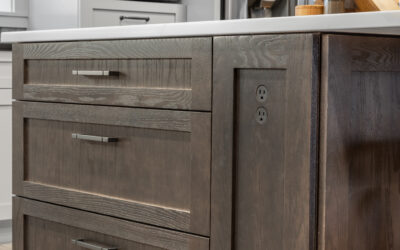
To get a quartersawn board, the log is first cut into quarters, and each quarter is then sliced at roughly a 45-degree angle to the growth rings. The result is a straight, uniform grain pattern on the face of the board — a very different look from the arches of plain-sawn lumber. In species like oak, quartersawing also exposes the wood’s medullary rays, creating the striking “ray fleck” pattern prized in Arts and Crafts and Mission-style furniture. Those flecks become especially vivid under a lighter stain. Quartersawn lumber is also more dimensionally stable than plain-sawn — less prone to cupping — but because the cutting process yields less usable wood per log, it costs more.
Rift-Sawn: Clean Lines for a Modern Look
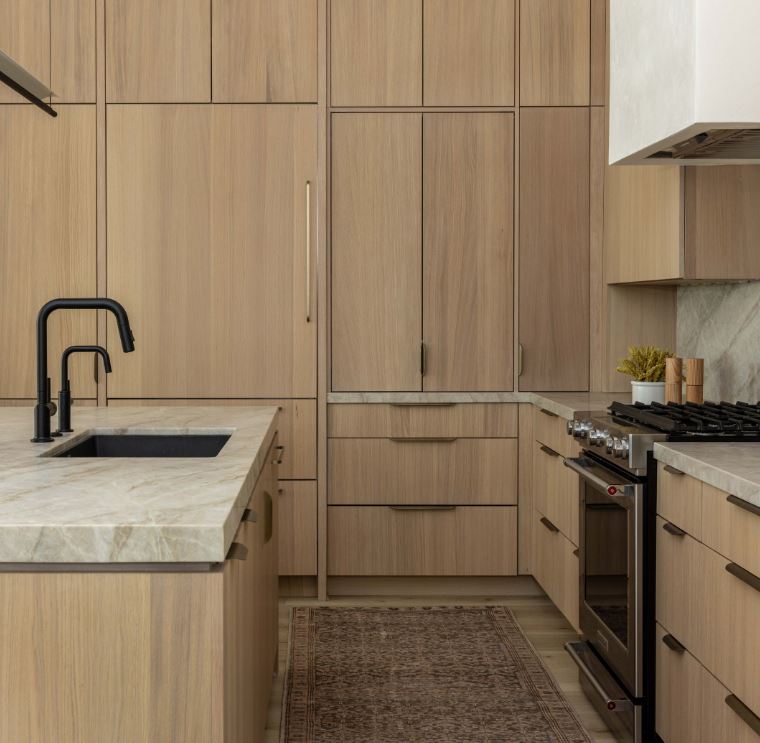
Rift-sawn lumber takes the quartering process a step further, rotating each quarter slightly between cuts to keep the grain angle consistent and minimize that ray fleck. What you get is a tight, linear grain that runs consistently across the face of the board — no arches, no dramatic flecking, just clean, straight lines. It’s become the go-to choice for homeowners leaning toward a modern or transitional kitchen, particularly in white oak. Rift-sawn is the most dimensionally stable of the three cuts, but it’s also the most expensive, since it produces the lowest yield of usable lumber from each log.
How the Cut Shows Up on Your Cabinets
The cut affects more than the look of a single door — it affects how consistent your whole kitchen feels. A door panel and the surrounding face frame are cut from different parts of the board, so if a cabinet shop isn’t paying attention, you can end up with mismatched grain between a door and its frame, or between adjacent cabinets. This is part of why it’s worth asking your showroom or cabinetmaker how they source and match lumber, especially if you’re set on an all rift-sawn or all quartersawn kitchen. It’s also worth knowing that stain choice interacts with all of this: a light or clear finish will show off grain character (and ray fleck) far more than a dark, opaque stain will, so the cut you choose matters most if you’re planning to let the wood tone show through.
Choosing the Right Cut for Your Home
There’s no single “correct” answer here — the right wood cut depends on the character of your home and the look you’re after. In an older Vermont farmhouse or a New Hampshire colonial, plain-sawn oak or maple with its bold cathedral grain, or a traditional quartersawn oak with visible ray fleck, tends to feel right at home. In a newer build or a kitchen you’re renovating toward a cleaner, more contemporary look, rift-sawn white oak delivers that quiet, linear consistency a lot of homeowners are after right now.
See the Difference in Person
Photos and descriptions can only tell you so much — grain pattern and ray fleck are something you really have to see and touch to appreciate. In our showroom, we keep door samples cut each of these ways so you can compare them side by side, under the stain colors you’re considering, before you commit to a direction. If you’re planning a kitchen or bath remodel in Vermont or New Hampshire and want to talk through which cut and species fit your space, stop by our showroom or call us at (603) 448-9700 to schedule a design consultation.